
 Balinder Walia
A quick, practical guide to Claude model tiers. For the full deep-dive with routing blueprints, prompting patterns, and a token-budget playbook, read the large article.
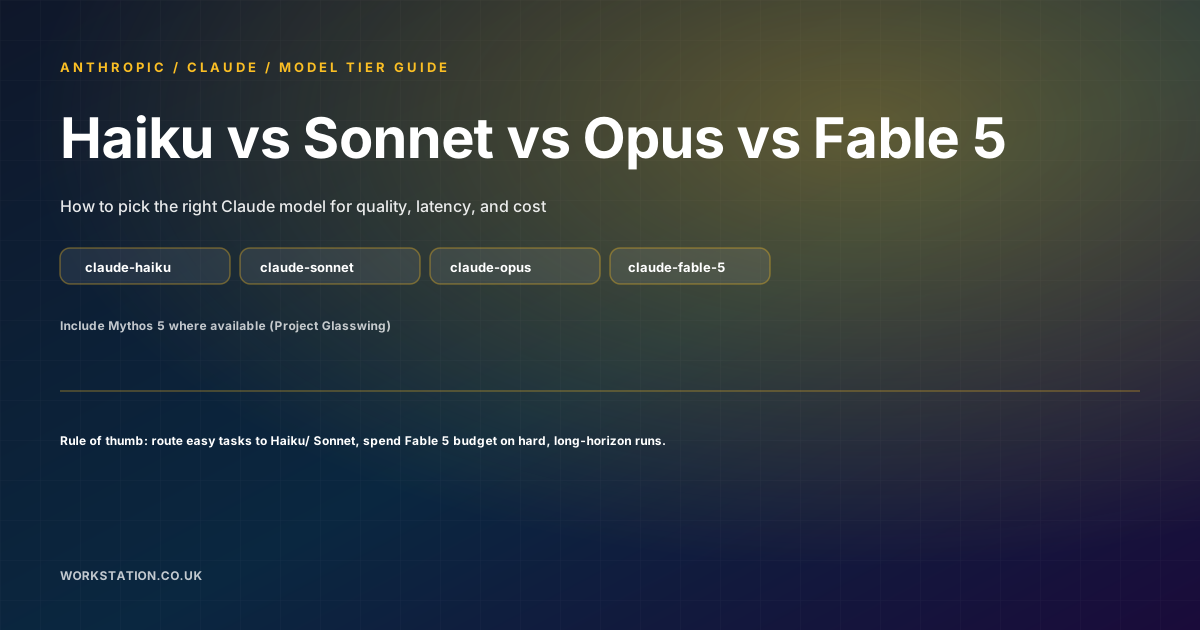
claude-haiku-4-5 for fast and cheap intent work, claude-sonnet-5 for the best speed/quality balance, claude-opus-4-8 for complex agentic coding and enterprise work, and reserve claude-fable-5 (and gated claude-mythos-5) for the truly hard, long-horizon jobs that take hours or days.
Model lineup at a glance
| Model | Best for | Context window | Max output | Pricing (input / output) | Thinking behavior |
|---|---|---|---|---|---|
Claude Fable 5 (claude-fable-5) |
Long-running agents and hardest unsolved problems | 1M tokens | 128K tokens | $10 / $50 per MTok | Adaptive thinking always on |
Claude Opus 4.8 (claude-opus-4-8) |
Complex agentic coding and enterprise work | 1M tokens | 128K tokens | $5 / $25 per MTok | Adaptive thinking always on |
Claude Sonnet 5 (claude-sonnet-5) |
Best speed/quality balance | 1M tokens | 128K tokens | $3 / $15 per MTok | Adaptive thinking always on |
Claude Haiku 4.5 (claude-haiku-4-5-20251001) |
Fastest model for cheap, high-volume tasks | 200K tokens | 64K tokens | $1 / $5 per MTok | Extended thinking available (adaptive off) |
Claude Mythos 5 (claude-mythos-5) is a gated model that shares the same specs and pricing as Fable 5, but does not include the safety classifiers used by Fable 5. Availability is limited to approved partners via Project Glasswing.
Pick the right model (quick rules)
- Haiku 4.5: routing, classification, extraction, and any workflow where you want fast replies and you cannot afford high output-token budgets.
- Sonnet 5: daily coding and document work where you want strong quality without Opus/Fable pricing.
- Opus 4.8: complex agentic coding, enterprise analysis, and harder debugging where longer, more autonomous work is required.
- Fable 5: the hard, long-horizon problems that take hours or days, especially when the model must keep the goal, delegate sub-tasks, and stay coherent.
Effort and thinking: how it impacts cost
On the API, effort is the primary control for the trade-off between intelligence, latency, and cost on Fable 5 and Mythos 5. For Opus 4.8 and Sonnet 5, you can also set effort explicitly when you need a different cost/latency profile.
Practical implication: defaulting every request to maximum effort is usually the fastest way to spend your budget on output tokens.
Token strategy that works across all tiers
Claude output tokens are the expensive part. A simple rule is: cap output length, prompt for TLDR-first, and use prompt caching so stable prefixes (system instructions and tool schemas) are reused.
- Use the cheapest model that can finish. A router (Haiku -> Sonnet/Opus -> Fable) often cuts cost dramatically while keeping quality high.
- Set output limits. In production, always set a max output / token cap. Unbounded answers are a budgeting accident.
- Use summaries strategically. Instead of sending full transcripts every turn, keep a compact “lessons” memory and only update it.
A simple router blueprint
- Classify intent and estimated complexity with
claude-haiku-4-5. - Send “normal hard” work to
claude-sonnet-5(orclaude-opus-4-8when you expect heavier agentic coding). - Escalate to
claude-fable-5only when the task is clearly long-horizon or has failed on lower tiers. - If Fable 5 refuses via safety classifiers, fall back to Opus 4.8 (the API supports refiring with fallbacks when configured).