This is the long-form deep-dive. For a quicker, skim-readable version, see the companion blog post.
1. Introduction: a new capability tier, not another point release
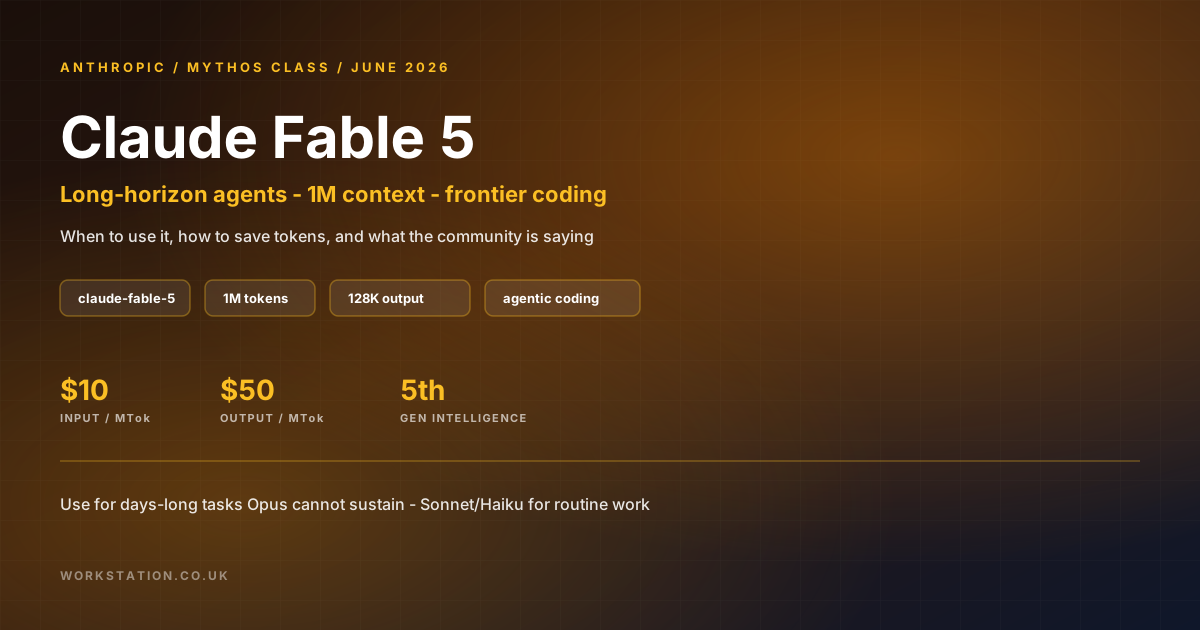
On 9 June 2026, Anthropic shipped Claude Fable 5 — the first generally available model in a new Mythos-class tier that sits above Opus 4.8 in the Claude lineup. This was not a routine benchmark bump. It was the public release of capabilities Anthropic had previously considered too powerful for unrestricted access, previewed in April 2026 as Claude Mythos Preview under Project Glasswing and limited to vetted cyber defenders and critical infrastructure operators.
After months of safety work — and visible community pressure around transparency — Anthropic made Fable 5 available to Pro, Max, Team, and Enterprise subscribers and to any developer with an API key. The model ID is claude-fable-5. Pricing is $10 per million input tokens and $50 per million output tokens, with a 1M-token context window and up to 128K output tokens per request.
This article explains what Fable 5 is, how the community has reacted, which YouTube reviews are worth your time, when the model earns its price tag, and how to control token spend when running long-horizon agents. It is written for engineering leads, platform teams, and builders integrating Claude into production workflows — not as vendor marketing, but as practical guidance from the launch window through July 2026.
2. What is Claude Fable 5?
2.1 Mythos-class: a tier above Opus
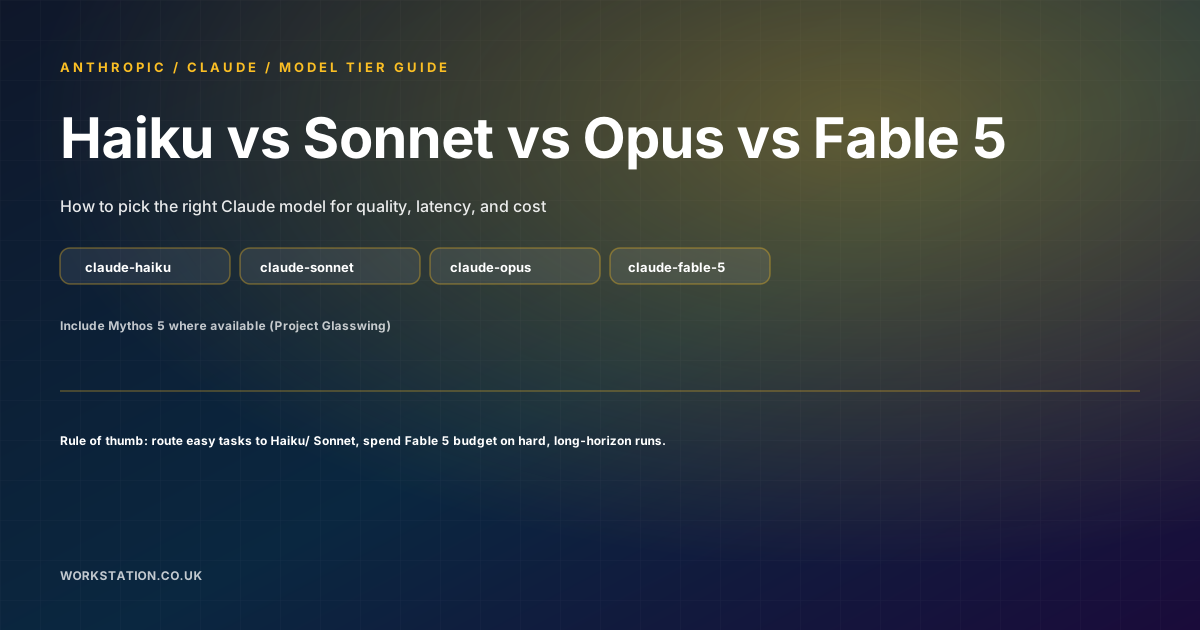
Anthropic now positions models across a spectrum of speed, price, and capability:
| Model | API ID | Best for | Context |
|---|---|---|---|
| Claude Fable 5 | claude-fable-5 | Long-horizon agents, hardest unsolved problems | 1M tokens |
| Claude Opus 4.8 | claude-opus-4-8 | Complex agentic coding, enterprise work | 200K tokens |
| Claude Sonnet 5 | claude-sonnet-5 | Best speed/intelligence balance | 128K tokens |
| Claude Haiku 4.5 | claude-haiku-4-5-20251001 | Fast, near-frontier intelligence | 64K tokens |
Fable 5 is Anthropic's answer to a specific failure mode of prior models: tasks that require sustained autonomy — gathering context across a large codebase, building, self-verifying, delegating subagents, and continuing for hours without losing the thread. Anthropic describes it as thorough, proactive, and inclined to test its own work.
2.2 Fable 5 vs Mythos 5
Claude Mythos 5 (claude-mythos-5) shares identical weights and pricing with Fable 5 but is available only through Project Glasswing to approved partners — primarily cyber defenders, critical infrastructure operators, and select biomedical researchers. The difference is not capability; it is access policy and safety architecture.
Fable 5 includes safety classifiers that can decline requests touching offensive cybersecurity techniques, sensitive biology and life sciences content, or extraction of the model's summarized thinking. When triggered, responses may return stop_reason: "refusal" or automatically fall back to Claude Opus 4.8. Anthropic states these fallbacks occur in fewer than 5% of sessions. Mythos 5 omits these classifiers for organisations whose work genuinely requires unrestricted frontier access in those domains.
2.3 Benchmarks and capability claims
Anthropic positions Fable 5 as state-of-the-art across software engineering, knowledge work, vision, and scientific research — with the critical caveat that its lead grows with task length and complexity. Community testers and launch-week YouTube reviews consistently highlight:
- SWE-bench Pro: large jump over GPT-5.5 and prior Claude models on real-world software engineering tasks.
- OSWorld / agentic environments: strong scores on multi-step computer-use benchmarks.
- Long-horizon coding: first-shot implementations of systems that previously required days of iteration on Opus.
- Vision: improved interpretation of dense technical screenshots, UIs, and noisy images — often with fewer output tokens than Opus.
- Code review: higher bug-finding recall across repositories and git history (outside classifier-covered cybersecurity domains).
Treat headline benchmark numbers as directional. Your workload, prompt scaffolding, and effort setting matter more than any single leaderboard row.
3. Community reactions: excitement, sticker shock, and guardrail backlash
3.1 What builders are saying
Early reactions from practitioners fall into three camps:
- "Finally — it finishes." Developers running Claude Code and custom agent harnesses report that Fable 5 sustains multi-hour runs with better instruction retention than Opus. Simon Willison's launch notes captured the tension well: slow and expensive, but it keeps working on problems that stall other models. Hacker News threads shifted from "another model launch" to "what happens when autonomous coding agents become broadly available?"
- "Best model, wrong price for my workflow." Independent API testers who rebuilt the same application on Fable 5, Opus 4.8, and GPT-5.5 often ranked Fable 5 first on quality but questioned whether the premium is justified for daily driver coding — especially at medium effort on tasks Opus handles adequately.
- "I don't know which model I'm talking to." The guardrail controversy. Researchers and developers complained when sensitive queries silently routed to Opus 4.8 without clear disclosure. Wired, The Verge, and Business Insider covered Anthropic's subsequent adjustments. The lesson for integrators: surface fallback events in your UI and logs — users paying frontier prices deserve to know.
3.2 YouTube coverage: signal vs noise
Launch week produced dozens of Fable 5 videos. Thumbnail superlatives ("Greatest AI Ever," "Terrifying") are marketing. The useful signal is in task traces: multi-hour runs, side-by-side comparisons, cost accounting, and honest failure modes.
| Video | Creator focus | What to look for |
|---|---|---|
| Claude Fable 5 in 7 Minutes | Launch summary | Benchmark overview, Mythos preview comparison, pricing context. |
| Claude Fable 5 IS INCREDIBLE! (Fully Tested) | Broad capability demo | Coding, 3D/WebGL, physics sims, vision, agentic workflows — widest test surface. |
| Claude Fable 5 just dropped and I'm speechless | Claude Code agent patterns | Goal loops, /loop hourly checks, Linear integration — how to think in autonomous cycles. |
| Fable 5 vs Opus — Don't Waste Credits | Head-to-head comparison | UI rebuilds, 3D game creation, document analysis — first-impression quality gaps. |
| I Spent $200 Testing Fable 5 | Cost-quality economics | Same app × three models; effort levels; "best ≠ best value" argument with real spend data. |
| Vibe Coding With Claude Fable 5 | Live coding stream | FPS in single HTML file, performance review of real codebase — vibe-check reality. |
| How to Use Fable 5 the Right Way | Official prompting patterns | Effort dial, lean prompts, parallel subagents — distilled from Anthropic's docs. |
How to watch critically: note the effort setting used, whether the reviewer shows token/credit spend, whether tasks are one-shot or iterative, and whether "wins" are visual polish or functional correctness. A model that produces a prettier landing page but breaks on edge cases is a different outcome than one that passes your test suite.
3.3 Ten interesting takeaways from launch week
- Mythos preview → Fable GA took ~8 weeks. The arc from restricted preview to safeguarded public launch is unusually fast for a tier Anthropic initially deemed too risky for general release.
- Fable 5 is not a drop-in Opus upgrade. Teams that migrated prompts unchanged often reported disappointment. Fable 5 wants leaner instructions and different harness timeouts.
- Effort is the primary cost lever. Medium Fable 5 frequently beats Opus at extra-high — a counterintuitive finding that changes routing economics.
- Output tokens are the budget killer. At $50/MTok output vs $10/MTok input, long agent monologues and unbounded summaries dominate spend.
- Parallel subagents are a first-class pattern. Fable 5 dispatches subagents more readily than prior models; blocking harnesses leave capability on the table.
- Memory files beat chat history. One lesson per Markdown note, updated not duplicated, outperforms re-pasting transcripts.
- "Show your thinking" prompts backfire. Reasoning-extraction instructions can trigger refusals and Opus fallbacks — use structured thinking blocks instead.
- Guardrail transparency became a product issue. Silent model switching erodes trust faster than explicit refusals.
- Subscription economics are shifting. Frontier models at API pricing may mark the end of heavily subsidised flat-rate access for Mythos-class intelligence.
- The long-task gap is the real story. Benchmarks matter; what changed behaviour is agents that run overnight and still remember the goal.
4. When to use Fable 5 — and when to route elsewhere
4.1 Task matrix
| Workload | Recommended model | Rationale |
|---|---|---|
| Multi-day codebase migration | Fable 5 (high/xhigh) | Sustained autonomy, cross-repo context, self-verification |
| Overnight agent with tool use | Fable 5 (high) | Long turns, parallel subagents, instruction retention |
| Ambiguous product spec → implementation | Fable 5 (high) | Scoping, clarifying questions, end-to-end delivery |
| Deep code review across monorepo | Fable 5 (medium–high) | Higher bug-finding recall, large context |
| Financial model / long enterprise doc | Fable 5 (medium–high) | Professional-grade output, scope discipline |
| Standard feature PR (well-scoped) | Opus 4.8 (high) | Near-parity quality at ~half the cost |
| Daily coding assistant | Sonnet 5 or Opus 4.8 | Latency, cost, good enough for most PRs |
| Classification / routing / triage | Haiku 4.5 | Cheapest; escalate only hard cases |
| Sub-second chat UX | Sonnet 5 or Haiku 4.5 | Fable 5 is comparatively slow on hard tasks |
| High-volume extraction with schema | Sonnet 5 or Haiku 4.5 | Deterministic tasks don't need Mythos-class reasoning |
4.2 Effort levels: the dial everyone ignores
On the API, effort is the primary control for trading intelligence, latency, and cost. Four levels exist: low, medium, high, and xhigh.
- high — default for most Fable 5 tasks worth running at all.
- xhigh — capability-sensitive workloads where cost is secondary to correctness.
- medium — routine work; frequently matches Opus at extra-high.
- low — fast back-and-forth; still often exceeds prior-generation max effort.
Anthropic's guidance and community testing converge on one rule: do not default everything to maximum effort. At high effort on simple tasks, Fable 5 may over-gather context, over-plan, and over-explain — burning output tokens without proportional quality gain. If a medium-effort Fable call matches your quality bar, an xhigh call is waste.
4.3 A practical escalation router
Production teams benefit from a three-tier router:
- Haiku classifies intent and complexity (cheap, fast).
- Sonnet or Opus handles the majority of coding, drafting, and analysis.
- Fable 5 engages only when: (a) the task failed twice on Opus, (b) estimated duration exceeds two hours of human effort, (c) the workflow is explicitly long-horizon agentic, or (d) cross-repo context exceeds Opus's window.
Log escalation reasons. After a month, most teams discover Fable 5 should serve 5–15% of requests, not 50%.
5. How to save tokens while using Fable 5
Fable 5's pricing asymmetry — output five times more expensive than input — makes token discipline existential on agent workloads. A single overnight run can consume millions of output tokens if the harness does not constrain verbosity.
5.1 Reducing input tokens
- Prompt caching. Fable 5 supports Anthropic's prompt caching with up to 90% discount on cached input prefixes. Cache your system prompt, tool definitions, and stable context. This is the single highest-ROI optimisation for multi-turn agents.
- Lean system prompts. Audit skills and instructions written for Opus. Fable 5 often performs better with shorter, intent-driven prompts. Remove enumerations of behaviours the model already handles by default.
- Memory files over transcripts. Maintain a
lessons.md(or per-topic notes) that Fable 5 updates after runs. Reference it instead of re-sending full chat history. Anthropic's recommended pattern: one lesson per file, one-line summary at top, update don't duplicate, delete wrong notes. - RAG with tight retrieval. When grounding in documents, retrieve only relevant chunks — not entire wikis. A 1M context window is not an invitation to fill it.
- Parallel subagents with scoped context. Each subagent receives only the files and instructions it needs, rather than one thread accumulating everything.
5.2 Reducing output tokens
- Set
max_tokensdeliberately. Unbounded generation is the fastest path to a surprise invoice. - TLDR-first instructions. Anthropic recommends: "Lead with the outcome. Your first sentence should answer what happened or what you found. Supporting detail comes after."
- Do not ask for reasoning in the response. Prompts that say "explain your thinking step by step" in user-visible text can trigger
reasoning_extractionrefusals. Read structuredthinkingblocks from adaptive thinking instead. - Use a
send_to_usertool. For long async agents, a client-side tool delivers progress updates verbatim without ending the turn — avoiding repeated full summaries in the main response stream. - Constrain scope creep. Add: "Don't add features, refactor, or introduce abstractions beyond what the task requires. A bug fix doesn't need surrounding cleanup."
- Separate verifier subagents. A fresh-context verifier checking work at intervals beats self-critique loops that generate redundant analysis text.
5.3 Harness-level optimisations
- Async, non-blocking architecture. Fable 5 turns on hard tasks can run many minutes. Blocking clients retry and duplicate context. Use webhooks, polling, or job queues.
- Hide context-budget countdowns. Surfacing "tokens remaining" to the model can trigger premature summarisation and handoff offers. If you must show budget, add reassurance: "You have ample context remaining. Continue the work."
- Handle refusals with explicit fallback. Configure server-side fallback to Opus 4.8 on
stop_reason: "refusal"— but log it and consider whether Opus can complete the task cheaper than retrying Fable. - Autonomous mode instructions. For unattended pipelines: "The user cannot answer questions mid-task. For reversible actions that follow from the original request, proceed without asking."
5.4 A rough cost mental model
Suppose an agent run generates 200K input tokens (with 80% cache hit rate) and 50K output tokens:
- Uncached input: 40K × $10/MTok = $0.40
- Cached input: 160K × $1/MTok = $0.16
- Output: 50K × $50/MTok = $2.50
- Total: ~$3.06 per run
Without caching and with verbose output, the same run could easily exceed $15. At 100 runs per day, that is the difference between a line item and a budget crisis.
6. Prompting Fable 5: patterns that matter
Anthropic published a dedicated Prompting Claude Fable 5 guide. The highest-impact patterns for production:
6.1 Start at the top of your difficulty range
Testing Fable 5 on simple workloads undersells it. Pick a task harder than what you'd assign Opus — let Fable scope it, ask clarifying questions, and execute. That is where the tier gap appears.
6.2 Give intent, not exhaustive rules
Instruction-following improved enough that brief steering beats long enumerations. Example brevity addendum:
Lead with the outcome. Be selective about what you include — drop details
that don't change what the reader would do next. If you've been working
for a while without the user watching, your final message is their first
look at any of it: outcome first, then what you need from them.
6.3 Checkpoint only when necessary
Pause for the user only when the work genuinely requires them: a destructive
or irreversible action, a real scope change, or input only they can provide.
6.4 Ground progress claims
Before reporting progress, audit each claim against a tool result from this
session. Only report work you can point to evidence for.
6.5 State boundaries explicitly
When the user is describing a problem rather than requesting a change,
the deliverable is your assessment. Report findings and stop. Don't apply
a fix until they ask for one.
7. Integration checklist
- Model string:
claude-fable-5(Bedrock:anthropic.claude-fable-5-3; Vertex:claude-fable-5). - Timeouts: extend client timeouts for high/xhigh effort — minutes, not seconds.
- Streaming: enable streaming with progress UI for long runs.
- Refusal handling: detect
stop_reason: "refusal"; configure Opus 4.8 fallback; log and surface to users. - Adaptive thinking only: Fable 5 uses adaptive thinking — no extended thinking budgets. Read thinking from structured blocks, not response text.
- Data retention: 30-day mandatory retention (Covered Model) — factor into compliance review.
- Prompt cache: implement cache breakpoints on stable prefixes.
- Effort parameter: expose effort in your internal tooling; default to
high, notxhigh. - Subagent harness: support parallel async subagents with scoped context.
- Cost dashboards: track input vs output tokens per model tier; alert on Fable 5 spend anomalies.
8. Anti-patterns
- Using Fable 5 for every Claude Code session — burns credits on tasks Sonnet completes in seconds.
- Migrating Opus skills verbatim — over-prescriptive prompts often degrade Fable 5 output.
- Max effort by default — pays premium latency and cost without proportional quality on routine work.
- Ignoring refusal/fallback events — you may be paying Fable prices for Opus responses without knowing.
- Blocking on subagents sequentially — leaves parallelisation gains on the table.
- Re-pasting full chat history — use memory files; cache stable prefixes.
- Testing only on toy prompts — Fable 5's value appears on multi-hour, multi-tool workloads.
9. Conclusion
Claude Fable 5 is Anthropic's bet that the next frontier of useful AI is not faster chat — it is agents that sustain work across hours and days. The community reaction confirms the capability is real: benchmarks up, long-horizon coding demos that impress even sceptical reviewers, and a new mental model of loops and goals rather than single prompts.
The friction is equally real: double Opus pricing, output-token economics that punish verbose agents, guardrail transparency controversies, and the discovery that Fable 5 is a different instrument — not a louder Opus. The teams that win will route intelligently (Haiku → Sonnet/Opus → Fable), tune effort instead of maxing it, implement prompt caching and lean prompts, and reserve Mythos-class intelligence for problems that actually require it.
Watch the YouTube reviews for task traces, not thumbnails. Read Anthropic's prompting guide before your first production migration. And if you have not yet failed on Opus — you probably do not need Fable 5 yet.
The companion blog post is the five-minute version for sharing with your team. This article is the reference.
Published by Workstation (workstation.co.uk). Official docs: anthropic.com/claude/fable · Introducing Claude Fable 5.
SEO snapshot for this article
- SEO title: Claude Fable 5 Guide: When to Use It, Token Savings, Community Reactions
- Meta description: Claude Fable 5 explained: Mythos-class capabilities, user reactions, popular YouTube reviews, when to use Fable vs Opus/Sonnet, and how to save tokens on long-horizon agents.
- Primary keywords: Claude Fable 5, claude-fable-5, Mythos class, Anthropic Fable 5, Fable 5 token savings, Claude Fable 5 vs Opus, agentic coding
- Twitter / X: Claude Fable 5 is live — Mythos-class, 1M context, built for days-long agentic work. We wrote the guide: when to use it, how to save tokens, community reactions, and the YouTube reviews worth watching. #ClaudeFable5 #AIagents
- LinkedIn: Anthropic's Claude Fable 5 is the first generally available Mythos-class model — and the community is split between "best model ever" and "best model, wrong price for daily use." We published a deep dive covering task routing, effort levels, token economics, guardrail backlash, and the YouTube reviews with actual signal. From Workstation.